Blog

  • Snorkeling Off Keawakapu Beach by Carolyn Martin

    Snorkeling Off Keawakapu Beach by Carolyn Martin

    Your April 2 Protection prompt inspired this poem based on one of my favorite vacation spots and activities: snorkeling with turtles on Maui. 

    Over the years, I’ve come to recognize where these lovely creatures hang out and watch with awe as they rise for air or swim from beach to beach. The last time I was there, I witnessed turtle-rescue volunteers lug a big critter out of the surf and cut away fishing line that had entangled her. What a dedication!

    Images such as the reef, boats, fish lines, the slashed shell, as well as parasites, shivers of sharks, and divers create the specific world the narrator and turtle share––and which I have witnessed. 

    The turn in the second stanza adds a current-events theme. “Headline news” motivates the narrator to plan to emigrate from earth above to the sea below. Here mutual protection will be celebrated with local fish: angels, tangs, butterflies. 

    I chose to use shorter lines to lend fluidity to the poem, and the lineation breaks make, I hope, make for easy reading. Finally, the ending rhymes––harmonize, butterflies, rise––provide the sense of an upbeat resolution for the narrator and her companion.

    Snorkeling Off Keawakapu Beach

    where I don’t have to speak to anyone
    except the turtle I hang out with
    on the third reef to the south.
    Ours, a fluid camaraderie:
    she ear-witnesses my splashing kicks
    and bemoans my headline news.
    I commiserate about boats, fish lines,
    fear, and grief and ask about the slash
    on her shell. “A hard year,” she replies
    in turtle-speak and lets me pat her fin.

    “As above, so below,” we almost agree.
    But, from what I know of betrayal and loss,
    lies and regret, earthlings are drowning
    in themselves and I am done with them.

    I’ll find a shelf on her reef so I can listen
    for fishermen and scrub parasites
    off her back. She’ll steer me away
    from shivers of sharks and divers with spears.
    And, if we plan it right, we’ll harmonize
    with choirs of angels, tangs, and butterflies
    singing down the sun, singing up its rise.

    Carolyn Martin is a recovering work addict who’s adopted the Spanish proverb, “It is beautiful to do nothing and rest afterwards” as her daily mantra. She is blissfully retired—and resting–– in Clackamas, Oregon. Her poems have appeared in more than 200 publications around the world. For more: www.carolynmartinpoet.com.

  • Stop Monkeying Around

    Q: What happened when the monkey scored the winning goal?

    A: The crowd went bananas.

    Q: How did the monkey start a flea circus?

    A: From scratch.

  • Nothing Exists

    Yamaoka Tesshu, as a young student of Zen, visited one master after another. He called upon Dokuon of Shokoku.

    Desiring to show his attainments, he said: “The mind, Buddha, and sentient beings, after all, do not exist. The true natured of phenomena is emptiness. The is no realization, no delusion, no sage, no mediocrity. There is no giving and nothing to be received.”

    Dokuon, who was smoking quietly, said nothing. Suddenly he whacked Yamaoka with his bamboo pipe. This made the youth quite angry.

    “If nothing exists,” inquired Dokuon, “where did this anger come from?”

    From Zen Flesh Zen Bones: A Collection of Zen and Pre-Zen Writings compiled by Paul Reps and Nyogen Senzaki

  • Spring Dreams by Michelle Holland

    Journal Mining Prompt

    I mined my journal,  chock full of my relationship with nature, in nature. I wanted to distill the quality and the relationship lyrically, with a song – a sonnet – lyric and inviting, to capture an ongoing leitmotif of the recurring experience, in dream and by streams, of feeling a part of the natural world. I’d like to be a stream, a rock in a stream, the ongoing and the static of existence.

    After gleaning phrases from my journal and responding to the photo, the sonnet began to form. I have since worked with rhythm and meter to capture more of a classic sonnet, without a set a rhyme scheme.

    Spring Dreams

    I am the dawn child of clear mountain streams
    one with the smooth sheen of rocks and pebbles,
    rings of waves eddy around curved boulders,
    a kaleidoscopic light in snow fed

    shallow flowing water, no color but
    what is borrowed from the sky. New green leaves
    create a mottled shade, sanctuary
    for rainbow trout. I will not drown, spread out,

    span the width from dirt bank to cool elbow
    of sand for my bare toes on a hot day.
    Can I be both, river and child, my heart
    alive under growing clouds, threat of rain?

    I hear the Rio Santa Barbara call,
    years flow past, water cold on my bare calves.

    Michelle Holland lives in Chimayó, New Mexico. Her poetry publications include “Event Horizon,” The Sound a Raven Makes, New Mexico Book Award for Poetry, Tres Chicas Press, and Chaos Theory, Sin Fronteras Press. Her books Circe at the Laundromat is forthcoming from Casa Urraca Press. Michelle is treasurer of New Mexico Literary Arts, and poet-in-residence at the Santa Fe Girls School.

  • The Monkey and the Jellyfish

    Children must often have wondered why jelly-fishes have no shells, like so many of the creatures that are washed up every day on the beach. In old times this was not so; the jelly-fish had as hard a shell as any of them, but he lost it through his own fault, as may be seen in this story.

    The sea-queen Otohime, whom you read of in the story of Uraschimatoro, grew suddenly very ill. The swiftest messengers were sent hurrying to fetch the best doctors from every country under the sea, but it was all of no use; the queen grew rapidly worse instead of better. Everyone had almost given up hope, when one day a doctor arrived who was cleverer than the rest, and said that the only thing that would cure her was the liver of an ape. Now apes do not dwell under the sea, so a council of the wisest heads in the nation was called to consider the question how a liver could be obtained. At length it was decided that the turtle, whose prudence was well known, should swim to land and contrive to catch a living ape and bring him safely to the ocean kingdom.

    It was easy enough for the council to entrust this mission to the turtle, but not at all so easy for him to fulfill it. However he swam to a part of the coast that was covered with tall trees, where he thought the apes were likely to be; for he was old, and had seen many things. It was some time before he caught sight of any monkeys, and he often grew tired with watching for them, so that one hot day he fell fast asleep, in spite of all his efforts to keep awake. By-and-by some apes, who had been peeping at him from the tops of the trees, where they had been carefully hidden from the turtle’s eyes, stole noiselessly down, and stood round staring at him, for they had never seen a turtle before, and did not know what to make of it. At last one young monkey, bolder than the rest, stooped down and stroked the shining shell that the strange new creature wore on its back. The movement, gentle though it was, woke the turtle. With one sweep he seized the monkey’s hand in his mouth, and held it tight, in spite of every effort to pull it away. The other apes, seeing that the turtle was not to be trifled with, ran off, leaving their young brother to his fate.

    Then the turtle said to the monkey, ‘If you will be quiet, and do what I tell you, I won’t hurt you. But you must get on my back and come with me.’

    The monkey, seeing there was no help for it, did as he was bid; indeed he could not have resisted, as his hand was still in the turtle’s mouth.

    Delighted at having secured his prize, the turtle hastened back to the shore and plunged quickly into the water. He swam faster than he had ever done before, and soon reached the royal palace. Shouts of joy broke forth from the attendants when he was seen approaching, and some of them ran to tell the queen that the monkey was there, and that before long she would be as well as ever she was. In fact, so great was their relief that they gave the monkey such a kind welcome, and were so anxious to make him happy and comfortable, that he soon forgot all the fears that had beset him as to his fate, and was generally quite at his ease, though every now and then a fit of home-sickness would come over him, and he would hide himself in some dark corner till it had passed away.

    It was during one of these attacks of sadness that a jelly-fish happened to swim by. At that time jelly-fishes had shells. At the sight of the gay and lively monkey crouching under a tall rock, with his eyes closed and his head bent, the jelly-fish was filled with pity, and stopped, saying, ‘Ah, poor fellow, no wonder you weep; a few days more, and they will come and kill you and give your liver to the queen to eat.’

    The monkey shrank back horrified at these words and asked the jelly-fish what crime he had committed that deserved death.

    ‘Oh, none at all,’ replied the jelly-fish, ‘but your liver is the only thing that will cure our queen, and how can we get at it without killing you? You had better submit to your fate, and make no noise about it, for though I pity you from my heart there is no way of helping you.’ Then he went away, leaving the ape cold with horror.

    At first he felt as if his liver was already being taken from his body, but soon he began to wonder if there was no means of escaping this terrible death, and at length he invented a plan which he thought would do. For a few days he pretended to be gay and happy as before, but when the sun went in, and rain fell in torrents, he wept and howled from dawn to dark, till the turtle, who was his head keeper, heard him, and came to see what was the matter. Then the monkey told him that before he left home he had hung his liver out on a bush to dry, and if it was always going to rain like this it would become quite useless. And the rogue made such a fuss and moaning that he would have melted a heart of stone, and nothing would content him but that somebody should carry him back to land and let him fetch his liver again.

    The queen’s councilors were not the wisest of people, and they decided between them that the turtle should take the monkey back to his native land and allow him to get his liver off the bush, but desired the turtle not to lose sight of his charge for a single moment. The monkey knew this, but trusted to his power of beguiling the turtle when the time came, and mounted on his back with feelings of joy, which he was, however, careful to conceal. They set out, and in a few hours were wandering about the forest where the ape had first been caught, and when the monkey saw his family peering out from the tree tops, he swung himself up by the nearest branch, just managing to save his hind leg from being seized by the turtle. He told them all the dreadful things that had happened to him, and gave a war cry which brought the rest of the tribe from the neighbouring hills. At a word from him they rushed in a body to the unfortunate turtle, threw him on his back, and tore off the shield that covered his body. Then with mocking words they hunted him to the shore, and into the sea, which he was only too thankful to reach alive. Faint and exhausted he entered the queen’s palace for the cold of the water struck upon his naked body, and made him feel ill and miserable. But wretched though he was, he had to appear before the queen’s advisers and tell them all that had befallen him, and how he had suffered the monkey to escape But, as sometimes happens, the turtle was allowed to go scot-free, and had his shell given back to him, and all the punishment fell on the poor jelly-fish, who was condemned by the queen to go shield-less for ever after.

    From The Violet Fairy Book edited by Andrew Lange

  • Oh Cat-mas Tree!

    Oh Cat-mas Tree!

    According to the details for this photo, this was taken during 2020, the year of the Pandemic.

    Clearly we are doing our best to make Christmas merry and bright.

    I’d say, thanks to our oldest cat, it worked.

  • Caught

    Late one night a man is driving down the road, speeding. A police officer pulls him over and says to the man, “Are you aware of how fast you were going?”

    The man replies “yes, I am. I’m trying to escape a robbery I got involved in.”

    The cop gives him a skeptical look and asks “you were robbed?”

    The man casually replies, “No, I committed the robbery.”

    The cop, shocked, says “So, you’re telling me you were speeding, and you committed a robbery?”

    “Yes,” the man says calmly. “I have the loot in the trunk.”

    The officer responds, “Sir, place your hands on the dashboard. I need your license and registration” and reaches into the car window.

    “Don’t do that!” the man yells fearfully. “You’ll find the gun in my glove compartment!”

    The cop withdraws his hand. “Wait here,” he says.

    The cop calls for backup. Soon, police cars and helicopters flood the area. The man is cuffed quickly and taken to a police car. Before he gets in a cop walks up to him and says, while gesturing to the cop that pulled the man over, “Sire, this officer informed us that you had committed a robbery, had stolen loot in the trunk of your car, and had a loaded gun in your glove box. However, we found none of these things in your car.”

    The man replies, “Yeah, and I bet that liar said I was speeding, too.”

  • Sonnet XLII

    Elizabeth Barrett Browning

    "My future will not copy fair my past"--
    I wrote that once; and thinking at my side
    My ministering life-angel justified
    The word by his appealing look upcast
    To the white throne of God, I turned at last,
    And there, instead, saw thee, not unallied
    To angels in thy soul! Then I, long tried
    By natural ills, received the comfort fast,
    While budding, at thy sight, my pilgrim's staff
    Gave out green leaves with morning dews impearled.
    I seek no copy now of life's first half:
    Leave here the pages with long musing curled,
    And write me new my future's epigraph,
    New angel mine, unhoped for in the world!
  • How Pun-ny

    I strung all my wrist watches together to make a belt. It was a waist of time.

    Thanks for explaining the word “copious” to me. It means a lot.

    I’d tell you a chemistry joke, but I don’t know if I’ll get a reaction.

  • How the Dragon Was Tricked

    How the Dragon Was Tricked

    From Griechtsche und Albanesische Marchen, von J. G. von Hahn. (Leipzig: Engelmann. 1864.)

    Once upon a time there lived a man who had two sons but they did not get on at all well together, for the younger was much handsomer than his elder brother who was very jealous of him. When they grew older, things became worse and worse, and at last one day as they were walking through a wood the elder youth seized hold of the other, tied him to a tree, and went on his way hoping that the boy might starve to death.

    However, it happened that an old and humpbacked shepherd passed the tree with his flock, and seeing the prisoner, he stopped and said to him, ‘Tell me, my son why are you tied to that tree?’ ‘Because I was so crooked,’ answered the young man; ‘but it has quite cured me, and now my back is as straight as can be.’ ‘I wish you would bind me to a tree,’ exclaimed the shepherd, ‘so that my back would get straight.’ ‘With all the pleasure in life,’ replied the youth. ‘If you will loosen these cords I will tie you up with them as firmly as I can.’ This was soon done, and then the young man drove off the sheep, leaving their real shepherd to repent of his folly; and before he had gone very far he met with a horse boy and a driver of oxen, and he persuaded them to turn with him and to seek for adventures.

    By these and many other tricks he soon became so celebrated that his fame reached the king’s ears, and his majesty was filled with curiosity to see the man who had managed to outwit everybody. So he commanded his guards to capture the young man and bring him before him.

    And when the young man stood before the king, the king spoke to him and said, ‘By your tricks and the pranks that you have played on other people, you have, in the eye of the law, forfeited your life. But on one condition I will spare you, and that is, if you will bring me the flying horse that belongs to the great dragon. Fail in this, and you shall be hewn in a thousand pieces.’ ‘If that is all,’ said the youth, ‘you shall soon have it.’ So he went out and made his way straight to the stable where the flying horse was tethered. He stretched his hand cautiously out to seize the bridle, when the horse suddenly began to neigh as loud as he could. Now the room in which the dragon slept was just above the stable, and at the sound of the neighing he woke and cried to the horse, ‘What is the matter, my treasure? is anything hurting you?’ After waiting a little while the young man tried again to loose the horse, but a second time it neighed so loudly that the dragon woke up in a hurry and called out to know why the horse was making such a noise. But when the same thing happened the third time, the dragon lost his temper, and went down into the stable and took a whip and gave the horse a good beating. This offended the horse and made him angry, and when the young man stretched out his hand to untie his head, he made no further fuss, but suffered himself to be led quietly away. Once clear of the stable the young man sprang on his back and galloped off, calling over his shoulder, ‘Hi! dragon! dragon! if anyone asks you what has become of your horse, you can say that I have got him!’ But the king said, ‘The flying horse is all very well, but I want something more. You must bring me the covering with the little bells that lies on the bed of the dragon, or I will have you hewn into a thousand pieces.’ ‘Is that all?’ answered the youth. ‘That is easily done.’ And when night came he went away to the dragon’s house and climbed up on to the roof. Then he opened a little window in the roof and let down the chain from which the kettle usually hung, and tried to hook the bed covering and to draw it up. But the little bells all began to ring, and the dragon woke and said to his wife, ‘Wife, you have pulled off all the bed-clothes!’ and drew the covering towards him, pulling, as he did so, the young man into the room. Then the dragon flung himself on the youth and bound him fast with cords saying as he tied the last knot, ‘To-morrow when I go to church you must stay at home and kill him and cook him, and when I get back we will eat him together.’ So the following morning the dragoness took hold of the young man and reached down from the shelf a sharp knife with which to kill him. But as she untied the cords the better to get hold of him, the prisoner caught her by the legs, threw her to the ground, seized her and speedily cut her throat, just as she had been about to do for him, and put her body in the oven. Then he snatched up the covering and carried it to the king.

    The king was seated on his throne when the youth appeared before him and spread out the covering with a deep bow. ‘That is not enough,’ said his majesty; ‘you must bring me the dragon himself, or I will have you hewn into a thousand pieces.’ ‘It shall be done,’ answered the youth; ‘but you must give me two years to manage it, for my beard must grow so that he may not know me.’ ‘So be it,’ said the king. And the first thing the young man did when his beard was grown was to take the road to the dragon’s house and on the way he met a beggar, whom he persuaded to change clothes with him, and in the beggar’s garments he went fearlessly forth to the dragon. He found his enemy before his house, very busy making a box, and addressed him politely, ‘Good morning, your worship. Have you a morsel of bread?’ ‘You must wait,’ replied the dragon, ’till I have finished my box, and then I will see if I can find one.’ ‘What will you do with the box when it is made?’ inquired the beggar.

    ‘It is for the young man who killed my wife, and stole my flying horse and my bed covering,’ said the dragon. ‘He deserves nothing better,’ answered the beggar, ‘for it was an ill deed. Still that box is too small for him, for he is a big man.’ ‘You are wrong,’ said the dragon. ‘The box is large enough even for me.’ ‘Well, the rogue is nearly as tall as you,’ replied the beggar, ‘and, of course, if you can get in, he can. But I am sure you would find it a tight fit.’ ‘No, there is plenty of room,’ said the dragon, tucking himself carefully inside. But no sooner was he well in, than the young man clapped on the lid and called out, ‘Now press hard, just to see if he will be able to get out.’ The dragon pressed as hard as he could, but the lid never moved.

    ‘It is all right,’ he cried; ‘now you can open it.’ But instead of opening it, the young man drove in long nails to make it tighter still; then he took the box on his back and brought it to the king. And when the king heard that the dragon was inside, he was so excited that he would not wait one moment, but broke the lock and lifted the lid just a little way to make sure he was really there. He was very careful not to leave enough space for the dragon to jump out, but unluckily there was just room for his great mouth, and with one snap the king vanished down his wide red jaws. Then the young man married the king’s daughter and ruled over the land, but what he did with the dragon nobody knows.

  • Evacuation Cat

    Evacuation Cat

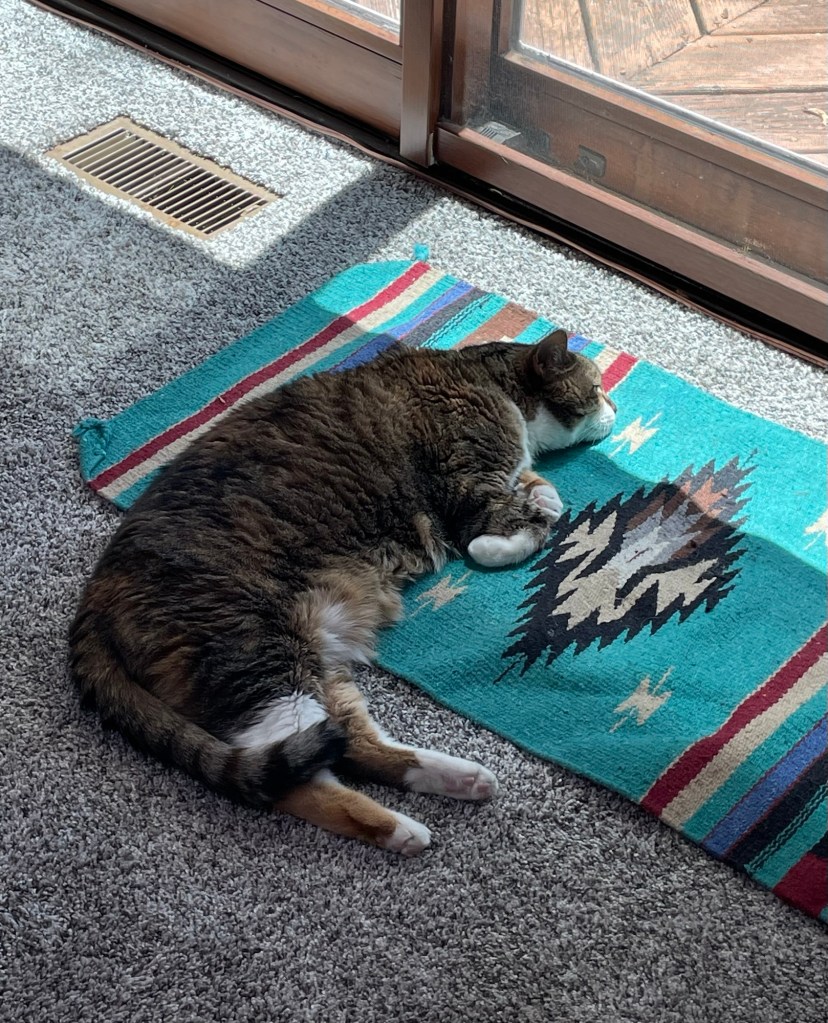
    Here, the oldest of our two cats contemplates her reflection and queries the meaning of life and identity.

    This was in a hotel I’d had found in Spartantburg that took cats during one of our hurricane evacuations (sometimes called a hurri-cation).

    I don’t recall which hurricane excatly because, after a while, all the named storms that came through during the eleven years we lived in Chalreston began to blur together.

    I could probably find it in my journals, though.

  • What’s Shadowdark Got to Do With It?

    What’s Shadowdark Got to Do With It?

    Winter in Pittsburgh, PA (not quite the Northeast, not quite the Midwest, but dark and cold nonetheless) is for building fires, reading epic novels, streaming new movies and old, knitting and embroidery, dreaming of spring–and spirits, completing jigsaw puzzles and, this year especially, playing Shadowdark with friends.

    My husband and I joined a Shadowdark game back in April when a good friend from a previous life texted an invitation. He’d been running this old school revival table top RPG for a group of friends and family and thought we, along with a few other friends, might like to try playing.

    After some discussion and trepidation on my part (a person who vacillates between being deeply competitive and not competitive at all) and a promise that the group would be open and friendly, we agreed to give Shadowdark a try.

    Not only did we enjoy playing that first round and spending time with good friends but we were hooked and eager to play again.

    Our friend created an online interface on Foundry for us, complete with maps and tokens and inventory sheets which allows us to play from our various locations across the US. We use discord voice chat to talk to each other in real time.

    For that first adventure, we explored the Secret of the Lost Citadel of the Scarlet Minotaur wherein we gathered treasure and had encounters will all manner of beings, from Beastmen and Ettercaps to the fierce Scarlet Minotaur who dwells within the Citadel’s confines.

    That was 15 sessions and six months ago. Since then, our friend the game master has further developed the interface with greater detail and imagery and our group has grown from three to five (sometimes six) players.

    Environments we’ve explored include the aforementioned Lost Citadel, the town of Orlene and it’s suspicious temple, the wilds of the forest and the mystery of the swamp and a labyrinthine world of underground tunnels.

    We’ve encountered everything from subservient Beastmen, giant spiders, putrid lizard men (Troglodytes), hypnotized cultists, magical elves, a wizard-type hermit, kind inn keepers, surly constable, wild animals like bear, a wolf, a trio of slug creatures, crocodiles and rats. On our last adventure, we even managed to secure a trio of horses after defeating bandits on the road.

    Having wanted to learn Dungeons and Dragons since high school but never quite finding the right opportunity or group to join, Shadowdark, which is every bit as involving but quicker paced, provides precisely the right mix of action and character development for the utmost fun.

    To say that I eagerly look forward to game night hardly captures my enthusiasm. Each one is another unique opportunity to stretch my imagination in new and surprising ways.

    Whether creating and developing a backstory for my character or improvising dialogue on the fly, I am challenged (in the best possible way) to think and act in an ever evolving world. Sort of like creative cross-training: consistent, engaging, builds ancillary skills, and most certainly keeps creative despondency at bay.

    Working collaboratively as a team also cultivates a sense of belonging for me, an only child and writer who has always preferred solitude, books, and staying at home. And, this winter, a couple of our team members are coming to visit so we can all attend the Philly Gaming Expo together.

    It will be epic.

  • Red Riding Hood and the Wolf (Lang version)

    Red Riding Hood and the Wolf (Lang version)

    from the Blue Fairy Book edited by Andrew Lang

    Once upon a time there lived in a certain village a little country girl, the prettiest creature was ever seen. Her mother was excessively fond of her; and her grandmother doted on her still more. This good woman had made for her a little red riding-hood; which became the girl so extremely well that everybody called her Little Red Riding-Hood.

    One day her mother, having made some custards, said to her:

    “Go, my dear, and see how thy grandmamma does, for I hear she has been very ill; carry her a custard, and this little pot of butter.”

    Little Red Riding-Hood set out immediately to go to her grandmother, who lived in another village.

    As she was going through the wood, she met with Gaffer Wolf, who had a very great mind to eat her up, but he dared not, because of some faggot-makers hard by in the forest. He asked her whither she was going. The poor child, who did not know that it was dangerous to stay and hear a wolf talk, said to him:

    “I am going to see my grandmamma and carry her a custard and a little pot of butter from my mamma.”

    “Does she live far off?” said the Wolf.

    “Oh! ay,” answered Little Red Riding-Hood; “it is beyond that mill you see there, at the first house in the village.”

    “Well,” said the Wolf, “and I’ll go and see her too. I’ll go this way and you go that, and we shall see who will be there soonest.”

    The Wolf began to run as fast as he could, taking the nearest way, and the little girl went by that farthest about, diverting herself in gathering nuts, running after butterflies, and making nosegays of such little flowers as she met with. The Wolf was not long before he got to the old woman’s house. He knocked at the door—tap, tap.

    “Who’s there?”

    “Your grandchild, Little Red Riding-Hood,” replied the Wolf, counterfeiting her voice; “who has brought you a custard and a little pot of butter sent you by mamma.”

    The good grandmother, who was in bed, because she was somewhat ill, cried out:

    “Pull the bobbin, and the latch will go up.”

    The Wolf pulled the bobbin, and the door opened, and then presently he fell upon the good woman and ate her up in a moment, for it was above three days that he had not touched a bit. He then shut the door and went into the grandmother’s bed, expecting Little Red Riding-Hood, who came some time afterward and knocked at the door—tap, tap.

    “Who’s there?”

    Little Red Riding-Hood, hearing the big voice of the Wolf, was at first afraid; but believing her grandmother had got a cold and was hoarse, answered:

    “‘Tis your grandchild, Little Red Riding-Hood, who has brought you a custard and a little pot of butter mamma sends you.”

    The Wolf cried out to her, softening his voice as much as he could:

    “Pull the bobbin, and the latch will go up.”

    Little Red Riding-Hood pulled the bobbin, and the door opened.

    The Wolf, seeing her come in, said to her, hiding himself under the bed-clothes:

    “Put the custard and the little pot of butter upon the stool, and come and lie down with me.”

    Little Red Riding-Hood undressed herself and went into bed, where, being greatly amazed to see how her grandmother looked in her night-clothes, she said to her:

    “Grandmamma, what great arms you have got!”

    “That is the better to hug thee, my dear.”

    “Grandmamma, what great legs you have got!”

    “That is to run the better, my child.”

    “Grandmamma, what great ears you have got!”

    “That is to hear the better, my child.”

    “Grandmamma, what great eyes you have got!”

    “It is to see the better, my child.”

    “Grandmamma, what great teeth you have got!”

    “That is to eat thee up.”

    And, saying these words, this wicked wolf fell upon Little Red Riding-Hood, and ate her all up.

  • The Youngest Who Shall Remain Unnamed

    The Youngest Who Shall Remain Unnamed

    We adopted the youngest of our two cats at the beginning of the pandemic, which makes her a little over five years old now, from a person who’d rescued her from the streets and took her and her litter mates to the vet for basic care, like immunizations and spay/neuter.

    Because of the youngest’s “colony cat” status, the vet who spayed her also clipped her ear to make it easy to know right away that she’d been fixed and wouldn’t be recaptured should she ever find herself on the streets again, which I plan to prevent to all costs.

    Youngest’s claws also happen to be incredibly long and sharp, earning her the affectionate designation of tough little street cat and survivor, though she is as sweet and cuddly as a bunny in a basket.

    I mean, I’ve never seen claws like these!

    One time, when we had the vet trim her claws, she skulked and hid for two days. We felt like bad cat-parents for traumatizing her like that and vowed never to put her through that again.

    Though it’s never intentional on survivor cat’s part, G and I have sustained more than a few impressively deep scratches when she’s leapt from our arms or laps to chase a shadow or tackle a can of wet cat food.

    Which is why we keep lots of Neosporin and Bandaids in the house.

  • Calling For Frost

    Calling For Frost

    When the weather is particularly nice in the spring and summer and I can hardly keep myself indoors, writing and knitting give way to outdoor interests and the creative joy of yard work.

    Though the yard where I live now is modest compared to my last two properties, each of which sat on nearly a half an acre of land, and the growing season here is shorter than anywhere I’ve lived before, the temperatures more variable, the seasons more distinct, I still find ways to fit gardening into my life.

    In the spring, there was the delightful, hopeful work of landscaping the bed along the front walk where I planted a couple of hosta lilies, three knock-out rose bushes, a couple of lavender plants, two Astilbe, and a lung wort plant. I then added mulch to keep things moist and weed resistant.

    I also hung a number of potted petunias, impatiens and a couple of Boston ferns on shepherd hooks across the front of the house to enhance the what I had planted in the garden beds and also add a little privacy around the window. .

    On the back deck out of reach of dear, I planted a few container tomato plants and nurtured them along with attention, water, and organic supplements. I traveled at exactly the wrong times, so they grew tall and lanky, yet they still produced about a dozen delicious if oddly-shaped fruit. I can just imagine how much better they will do next year if I am more attentive.

    Fungus and blight became the main concern during the hot, wet summer (and this year was wet indeed) as was creating shade for the tomatoes on the deck.

    Other than that, there was a lot more sitting in the shade or the air conditioned house (more writing and knitting.)

    This fall brought a drought so even though the growing season was winding down I found myself out in the yard watering the hydrangeas and the elephant ears I’d planted in late June to keep them all from giving up entirely in the dry heat.

    November calls for trimming trees and shrubs, raking copious leaves and getting them to the curb for the street cleaners and, here in Northern Appalachia (a new environment for me), planting bulbs, hilling rose bushes, and mulching the heck out of delicate perennials to protect them from impending winter cold.

    The news of the season’s first frost sent me back out into the yard today after I returned home from teaching to bring in all the “free range” house plants I’d set around the sidewalk and the Boston Ferns hanging on the shepherd’s hooks are transitioning on the screened porch.